
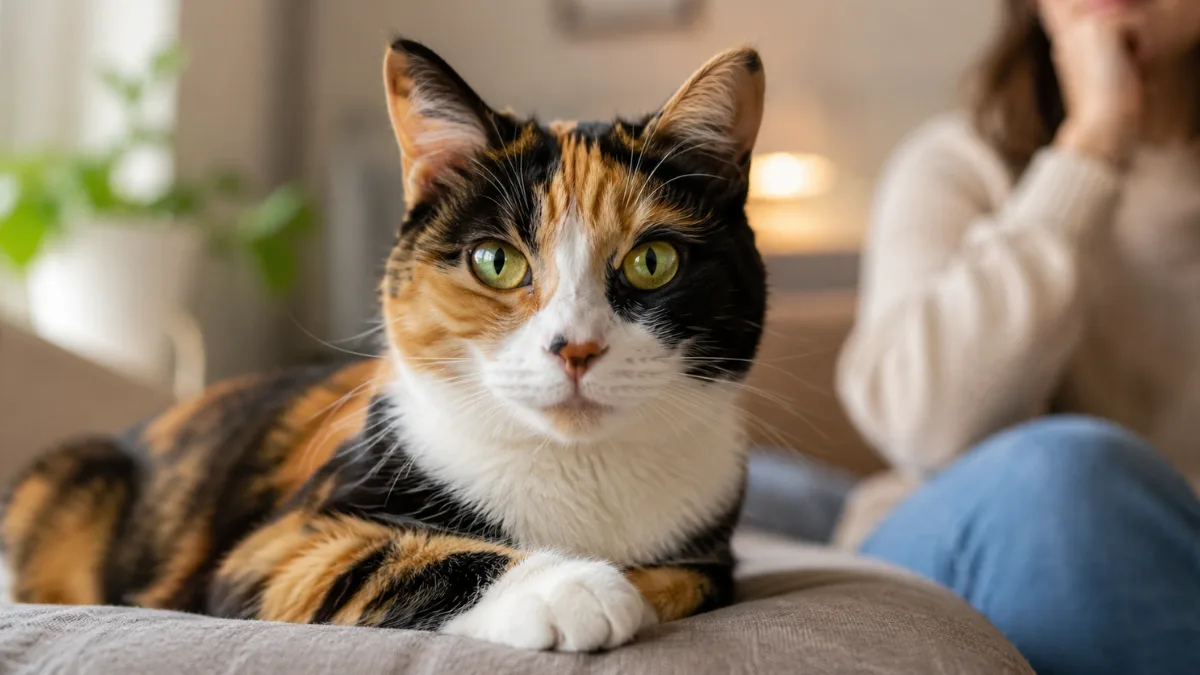

A calico coat does not reliably predict a cat’s personality. Owners often describe calico cats as bold, affectionate, independent or sassy but individual temperament varies far more than the stereotype suggests.
Calico describes a coat pattern rather than a breed. A calico cat may be calm or energetic, social or reserved, tolerant or sensitive. Inherited temperament, early socialisation, health, past experiences and the home environment offer more useful clues than coat colour alone.
Do Calico Cats Have a Distinct Personality?
Calico cats do not share one scientifically established personality type. Their orange, black and white patches explain how they look, but they cannot reveal whether a particular cat will enjoy being held, welcome visitors or become irritated during petting.
The calico pattern appears in cats with different breed backgrounds and physical characteristics. Two calicos may look similar while behaving very differently because they inherited different tendencies and experienced different environments.
One calico may confidently approach strangers and demand attention. Another may hide when visitors arrive and reserve affection for one trusted caregiver. Both personalities fall within normal feline variation.
Owners should therefore treat terms such as “calico personality” and “calico attitude” as descriptions of a popular reputation, not a dependable behavioural profile.
Why Do Calico Cats Have a Sassy Reputation?
Calico cats have a long-standing reputation for being fiery, dramatic and strong-willed. Owners sometimes describe a confident calico as having “calico attitude,” while tortoiseshell cats receive the similar nickname “tortitude.”
These labels usually refer to noticeable behaviours such as vocal protests, selective affection, resistance to handling or a willingness to defend personal space. However, cats of every colour can display the same behaviours.
Confirmation bias may help the stereotype survive. Someone who expects a calico to be feisty may notice every hiss, impatient meow or dramatic reaction while treating quiet and affectionate behaviour as ordinary.
The cat’s striking appearance may also make her behaviour more memorable. People often connect a distinctive appearance with a distinctive personality even when one does not directly cause the other.
Similar assumptions surround personality stereotypes linked to orange colouring. These popular descriptions can be entertaining, but they should not replace observation of the individual cat.
Are Calico Cats More Aggressive Than Other Cats?
There is no strong evidence that every calico cat is naturally aggressive. One frequently discussed study found an association between certain coat-colour groups and aggression reported by owners, but the findings need careful interpretation.
The researchers collected online survey responses from cat caregivers and analysed 1,274 completed surveys. Owners reported somewhat more human-directed aggression among sex-linked orange females, a group that included calicos, tortoiseshells and torbies.
The researchers grouped these coat patterns together. The results therefore did not provide a separate aggression score for calico cats alone.
The study also relied on owner reports rather than direct behavioural observation. Different people may describe a warning nip, playful swat or defensive reaction as aggression, even though those behaviours can occur for different reasons.
Differences during handling and veterinary visits were also small across coat-colour groups. The study identified an association in reported behaviour, but it did not prove that calico colouring causes aggression.
A calico may bite or swat because she feels frightened, overstimulated, frustrated or physically uncomfortable. Another calico may tolerate handling calmly throughout her life. Coat pattern alone cannot predict either response.
What Actually Shapes a Calico Cat’s Temperament?
A cat’s temperament develops through several influences working together. Some tendencies may appear early, while experience and environment continue to shape behaviour throughout life.
Inherited Temperament
Cats can inherit tendencies related to confidence, activity, sensitivity and sociability. Breed ancestry may also influence general behaviour, although individual variation remains important.
A calico Persian, Maine Coon and domestic shorthair may share similar colouring but show different activity levels, vocal habits and responses to handling.
Early Socialisation
Positive early experiences can help a kitten become comfortable with people, ordinary household sounds and gentle handling. Limited or frightening contact may make a cat more cautious.
A calico that avoids visitors may have received little early socialisation or may have learned that unfamiliar people feel unsafe. That reaction does not prove she has a naturally unfriendly calico personality.
Past Experiences
Cats remember situations that produced comfort, fear or pain. A rescued calico may initially avoid hands if people handled her roughly in the past.
Repeated safe interactions can improve trust, but progress should follow the cat’s pace. Forced contact can strengthen fear and defensive behaviour.
Home Environment
Cats usually cope better when they have predictable routines, safe resting places and control over social contact. Food, water, litter trays, scratching surfaces and resting spaces should remain easily accessible.
Competition with other pets, constant noise or a lack of hiding places can increase stress. A stressed calico may become withdrawn, vocal or defensive even when she previously appeared relaxed.
Age and Health
Kittens often display energetic play, chasing and impulsive biting. Adult cats may become more settled, while senior cats may prefer shorter interactions and quieter spaces.
Pain can also change behaviour. A cat with physical discomfort may resist touch, hide, hiss or swat when someone approaches a sensitive area.
These influences explain why two calico cats can behave very differently despite sharing the same coat pattern.
Are Calico Cats Affectionate or Independent?
Calico cats can be affectionate, independent or a mixture of both. Some enjoy sitting on laps and receiving frequent attention, while others prefer remaining nearby without being held.
Affection does not always involve constant physical contact. A calico may show trust by following a caregiver, sleeping nearby, rubbing her face against a hand, kneading, purring or greeting the person with an upright tail.
She may also seek contact briefly and then move away. This does not necessarily indicate anger or rejection. Cats often control the timing and length of social interaction.
A calico that avoids laps may still maintain a strong bond. Sitting in the same room, waiting near a familiar doorway or choosing a nearby sleeping place can show social attachment.
The most useful question is not whether calicos are generally affectionate. It is how a particular calico prefers to receive and express affection.
Why Might a Calico Cat Bite, Hiss or Swat?
Biting, hissing and swatting do not automatically mean that a calico is mean or aggressive. The surrounding situation and body language help explain what the behaviour means.
Play
Kittens and energetic adults may chase hands, grab ankles or deliver quick bites during play. These actions copy parts of hunting behaviour.
Interactive toys can provide a safer target. Caregivers should avoid using fingers or feet as toys because this teaches the cat that human skin is suitable for chasing and biting.
Petting Overstimulation
A cat may initially enjoy petting but become uncomfortable when the contact continues for too long. Tail flicking, skin twitching, flattened ears, tense muscles or a sudden head turn may appear before a bite.
Stopping at the first warning sign gives the cat space and reduces the chance of escalation. The behaviour can resemble the overstimulation described when a cat licks and then bites during an interaction.
Fear or Stress
A frightened cat may hiss, crouch or swat when she feels trapped. Chasing, cornering or forcing contact usually increases fear.
The safest response is to create distance and allow the cat to retreat. Punishment may suppress a warning temporarily, but it can also damage trust and make future reactions less predictable.
Pain or Illness
A sudden behavioural change may signal physical discomfort. A cat that previously accepted touch may begin biting when someone handles a painful area.
A veterinarian should examine the cat when biting or swatting starts suddenly, becomes more frequent or appears with appetite changes, hiding, litter-box problems, difficulty jumping, excessive grooming or sensitivity to touch.
A sudden change is a possible health or stress signal, not proof of a calico personality trait.
How Can an Owner Understand a Calico’s Individual Personality?
Observation provides a more accurate personality profile than any coat-colour stereotype. Caregivers can watch when the cat seeks contact, what type of touch she accepts and which situations cause tension.
A relaxed cat may hold her body loosely, keep her ears in a neutral position and approach with her tail raised. She may rub against familiar people, rest nearby or look at them with soft eyes.
A calm slow blink can form part of relaxed feline communication, although it should be read alongside the rest of the cat’s posture and the surrounding situation.
A tense cat may crouch, flatten her ears, lash her tail, freeze or attempt to move away. Continuing to touch or restrain her after these signals can lead to hissing, scratching or biting.
Context also matters. A swat during energetic play means something different from a swat during petting, a veterinary visit or an encounter with another animal.
Caregivers can build trust by allowing the cat to approach voluntarily and pausing during petting to see whether she requests more contact. Predictable routines, interactive play and accessible resting places can also support secure behaviour.
A calico’s coat explains her distinctive appearance, but it cannot reveal whether she will enjoy being held, welcome strangers or react strongly to petting. Her body language, history, triggers and preferred type of contact provide a far more accurate description than the calico-attitude label.

1 thought on “Calico Cat Personality: Are They Really Sassy or Aggressive?”