
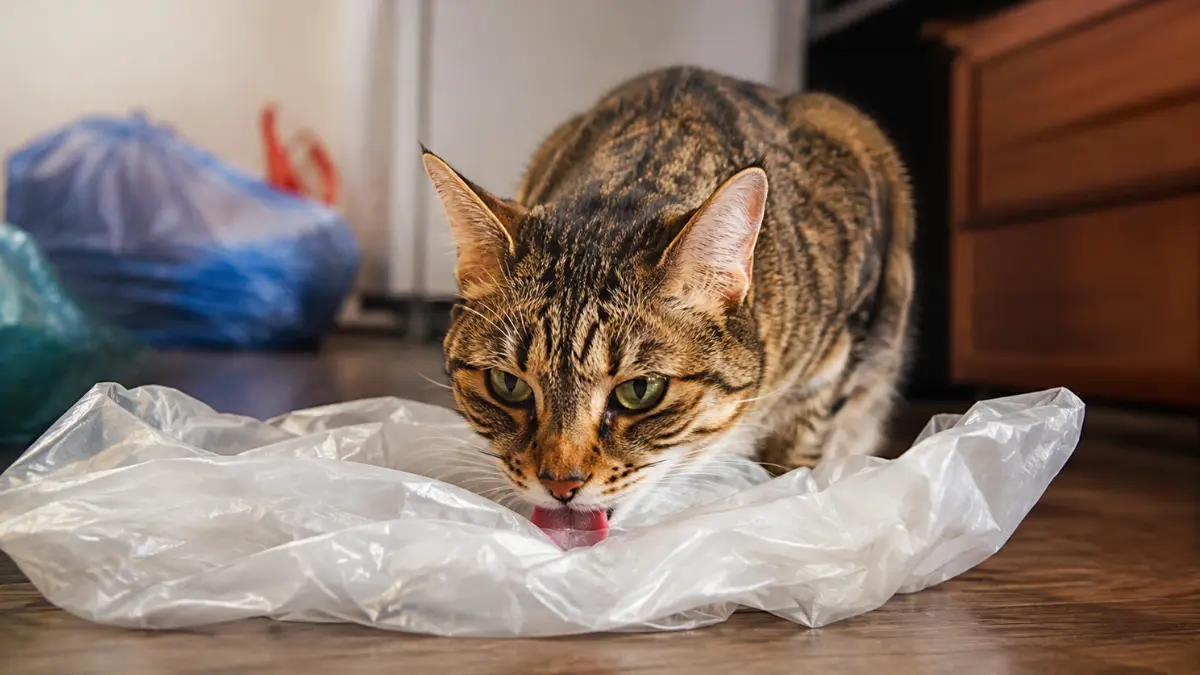

A cat may lick a plastic bag while investigating its smell, surface or movement or the behaviour may form part of a repetitive oral habit. Licking plastic does not automatically mean that a cat has pica but repeated chewing or swallowing plastic can cause a dangerous digestive obstruction.
The most important question is not simply why the cat touches the bag. Owners should determine whether the cat only licks it, repeatedly sucks or chews it, tears pieces away or actually swallows plastic.
Those behaviours do not carry the same level of risk.
Why Does My Cat Lick Plastic Bags?
Veterinary research has not identified one proven explanation that applies to every cat. Plastic-directed behaviour can involve ordinary investigation, attraction to something previously carried inside the bag, repetitive oral behaviour or an underlying medical or behavioural problem.
The pattern matters more than any single theory.
The bag may carry an interesting smell
A grocery or food-storage bag may retain traces of meat, fish, dairy products or another strongly scented item. A cat may investigate those traces by sniffing and licking the surface.
This is a practical possibility rather than a diagnosis. Owners should not assume that the bag itself contains a particular ingredient that attracts all cats.
Cleaning reusable bags and storing disposable packaging away from food-preparation areas may reduce this type of interest.
The cat may be exploring the object
Cats frequently investigate unfamiliar objects by sniffing, pawing, mouthing or licking them. A lightweight bag changes shape when touched and creates movement that may hold a curious cat’s attention.
WhyWorld’s guide to why cats knock things over explains how cats use their paws and repeated interaction to test unfamiliar household objects.
A brief investigation does not necessarily indicate a disorder. However, owners should still remove plastic because curiosity can progress from licking to biting and swallowing.
It may be an oral repetitive behaviour
The Merck Veterinary Manual explains that abnormal oral repetitive behaviours in cats may include sucking, licking, chewing or ingesting materials such as plastic, fabric, rubber, paper and string.
Stress or anxiety can worsen repetitive behaviour in some cats. An owner’s response can also unintentionally maintain a habit when touching the bag consistently results in attention, play or another rewarding reaction.
A compulsive disorder should not be diagnosed from plastic licking alone. Veterinarians first need to rule out medical problems and consider the cat’s complete behavioural history.
Age may influence object-directed behaviour
Young cats commonly explore their environment with their mouths. A longitudinal study of pet cats found that owner-reported pica was more common at approximately six months of age than at later stages, and plastic was among the most commonly targeted materials.
However, many young cats stopped displaying the behaviour as they matured. Persistent or worsening behaviour deserves more attention than an isolated episode. The study can be read through the National Library of Medicine.
Boredom may contribute, but it is not a complete diagnosis
A cat with too little play or environmental stimulation may direct more attention toward available household objects. Increasing safe activity can therefore form part of a management plan.
However, owners should not assume that every cat licking plastic is bored. A peer-reviewed case-control study found that feline pica was not simply explained by an inadequate environment or early weaning. Cats with pica also vomited more frequently than control cats, although the study did not establish which problem caused the other.
The study summary is available through Europe PMC.
Does Licking Plastic Mean My Cat Has Pica?
Licking plastic alone does not necessarily meet the strict definition of pica. Pica describes persistent ingestion of material that is not food.
A cat may lick or suck an object without swallowing it. That behaviour can still be repetitive or abnormal, but owners should avoid labelling it as pica without evidence of ingestion.
Concern increases when the cat:
- Repeatedly searches for plastic
- Bites holes in bags or packaging
- Tears pieces away
- Swallows plastic
- Eats other non-food materials
- Becomes difficult to redirect
- Suddenly develops the behaviour as an adult or senior
- Shows weight, appetite, dental or digestive changes
VCA Animal Hospitals identifies several possible medical and behavioural associations with pica, including gastrointestinal disorders, anemia, anxiety, compulsive behaviour, an unbalanced diet, diabetes, hyperthyroidism and neurological disease.
International Cat Care also notes that dental pain or abdominal discomfort may contribute in some cats.
These possibilities do not mean that every affected cat has one of these conditions. They explain why persistent chewing or ingestion requires a veterinary assessment rather than a home diagnosis.
Is Licking a Plastic Bag Dangerous?
A single lick does not have the same risk as swallowing a piece of plastic. The danger increases when the cat begins chewing, tearing or ingesting the material.
Plastic does not break down like normal food. A swallowed piece may become lodged in the esophagus, stomach or intestines.
A foreign-body obstruction can interfere with the movement of food and fluid through the digestive tract. It may also reduce the blood supply to affected tissue or damage the intestinal wall.
According to International Cat Care, owners should contact a veterinary clinic promptly when they believe a cat has swallowed something it should not have eaten. Waiting to see whether an object passes can delay necessary treatment.
What Should I Do If My Cat Swallowed Plastic?
Contact a veterinarian as soon as possible after known or strongly suspected plastic ingestion.
Provide as much information as possible:
- The type of plastic
- The approximate amount missing
- When the incident occurred
- Whether the plastic was soft, sharp, folded or strip-like
- Whether food, cleaner or another substance was on it
- Whether the cat has eaten, vomited or passed stool since the incident
Do not deliberately make the cat vomit unless a veterinarian or qualified poison-control professional gives that instruction. Some objects or substances can cause further injury when brought back through the esophagus.
A veterinarian may recommend an examination, observation or diagnostic imaging. VCA’s foreign-body guidance explains that assessment may involve X-rays, contrast imaging or ultrasound, depending on the object and the cat’s condition.
Not every type of plastic appears clearly on a standard X-ray. Veterinarians may instead identify changes in the stomach or intestines that suggest an obstruction.
What Are the Warning Signs of an Obstruction?
A cat may show symptoms soon after swallowing plastic, or signs may develop later as the material moves through the digestive system.
Seek urgent veterinary advice if a cat that may have swallowed plastic develops:
- Vomiting or repeated retching
- Refusal to eat
- A sudden reduction in appetite
- Lethargy or unusual hiding
- Abdominal pain
- Diarrhea
- Straining to defecate
- Passing only small amounts of stool
- Growling or resisting when the abdomen is handled
- Drooling or repeated swallowing
Cats often conceal pain and illness. Sleeping more, avoiding interaction or behaving differently may be the first noticeable signs.
Passing some stool does not prove that the digestive tract is completely clear. A partial obstruction may still allow a limited amount of material to pass.
How Can I Stop My Cat Licking Plastic Bags?
The safest approach combines removing access with identifying possible medical, behavioural or environmental contributors.
Store plastic securely
Keep shopping bags, food packaging, bin liners and wrappers inside closed cupboards or containers.
Do not leave plastic bags on floors, counters or furniture. Even a cat that has previously only licked a bag may eventually bite through it.
Use a bin with a secure lid and remove food-contaminated packaging promptly.
Offer safe enrichment
Provide activities that encourage stalking, pouncing, climbing, searching and problem-solving.
Useful options include:
- Wand-toy sessions
- Food puzzles
- Treat-dispensing toys
- Climbing furniture
- Window perches
- Short reward-based training sessions
- Toys rotated regularly to preserve novelty
The Cornell Feline Health Center recommends avoiding toys with small or string-like parts that can detach and be swallowed.
Cardboard boxes can provide a safer supervised outlet for hiding and exploration when staples, tape and loose plastic have been removed. WhyWorld’s article on why cats love boxes explains why enclosed cardboard spaces appeal to many cats.
Cats that chew or swallow cardboard should not receive it as an unsupervised alternative.
Do not punish the cat
Yelling, hitting or spraying the cat with water does not address the underlying reason for the behaviour. Punishment may increase fear or conflict and can worsen anxiety-related habits.
Calmly interrupt access, remove the plastic and redirect the cat toward an appropriate activity.
Reward the cat for interacting with a safe toy or puzzle rather than creating a dramatic reaction around the plastic.
Record the pattern
Keep a brief record of:
- When the behaviour happens
- How long it lasts
- Whether it occurs near meals
- Whether the cat licks, chews or swallows
- What type of plastic is targeted
- Recent household or routine changes
- Any vomiting, appetite or stool changes
A video may also help a veterinarian understand the behaviour, provided recording it does not require leaving the cat in danger.
Arrange a veterinary appointment when it persists
Book an examination when the behaviour becomes frequent, progresses to chewing, involves several non-food materials or begins suddenly.
The veterinarian may assess the cat’s mouth, teeth, diet, weight and digestive health. Blood, urine, fecal or imaging tests may be appropriate when an underlying condition is suspected.
A veterinary behaviourist may help when medical causes have been investigated and the behaviour appears compulsive or anxiety-related.
Sources
- VCA Animal Hospitals: Pica in Cats
- International Cat Care: Pica in Cats
- International Cat Care: Cats and Foreign Bodies
- Merck Veterinary Manual: Behavior Problems of Cats
- Cornell Feline Health Center: Safe Toys and Gifts
- National Library of Medicine: Owner-Reported Pica in Domestic Cats
- Europe PMC: Characterization of Pica and Chewing Behaviors in Cats
