
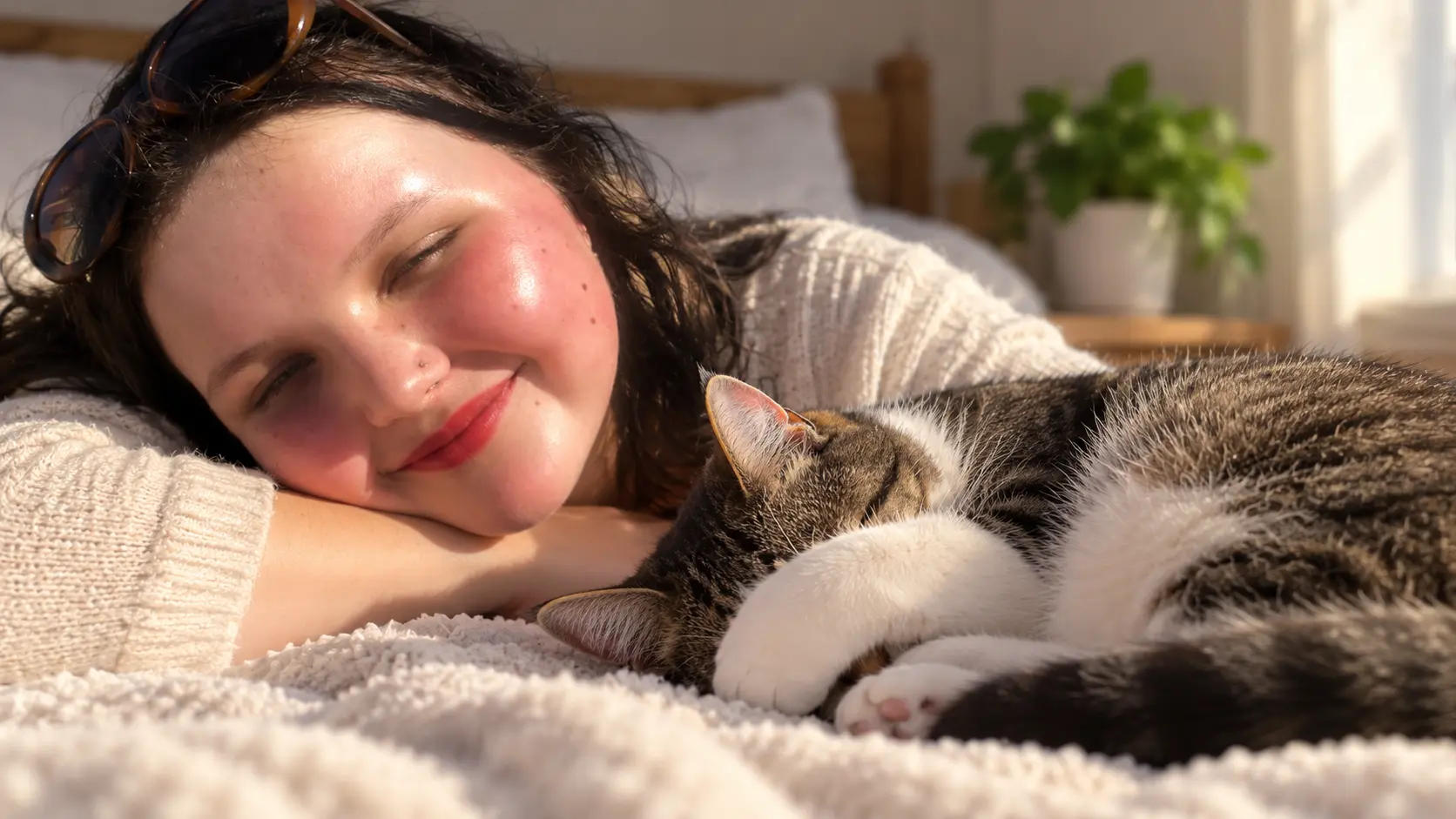

You walk past the couch and there it is again: your cat curled into a ball, completely asleep, with one paw laid neatly across the eyes. Sometimes only the nose disappears underneath. Sometimes both paws come up, making it look as though your cat has decided the room is simply too much for today.
It is adorable, but the position is not necessarily random. Cats adjust the way they sleep according to things such as light, temperature, comfort, and how secure they feel in a particular spot. Covering the face can make a bright or chilly sleeping place more comfortable, while curling up also fits the instinctive way cats protect vulnerable parts of their bodies when resting.
So why do cats cover their faces when they sleep? Most often, the paw is helping block light, preserve warmth, or simply create a more sheltered and comfortable sleeping position. And occasionally, the explanation is even simpler: your cat fell asleep that way after grooming and saw no reason to move.
Quick Answer
Cats commonly cover their faces while sleeping to block bright light, stay warm while curled up, and feel more sheltered while resting. A paw over the eyes can work much like a small sleep mask, while tucking the nose and face inward helps reduce exposure to cooler air. Some cats also fall asleep with a paw near their face after grooming.
3 Core Reasons Explained
1. The Feline Sleep Mask
Cats are built to see particularly well in dim conditions. They also sleep a lot—most cats spend around 12 to 16 hours asleep each day—so plenty of their resting happens when the house is still bright or sunlight is coming through the windows.
A paw placed over the eyes creates a little patch of shade. It is not so different from a person pulling a blanket over their eyes when sunlight reaches the bed. Veterinary explanations of feline sleeping positions specifically include blocking light as one reason cats may sleep with their paws over their eyes.
The cat probably is not consciously thinking about turning its paw into a sleep mask. More likely, it shifts around until the position feels comfortable and then stays there.
You may even notice a pattern with your own cat. The paw mask might appear more often during afternoon naps near a bright window and disappear when the same cat sleeps in a darker room.
2. The Built-in Radiator
Cats naturally run warmer than people. A normal feline body temperature is generally around 100°F to 102.5°F, although an individual cat’s normal temperature can vary slightly.
When the room feels cool, curling tightly into a ball helps a cat retain warmth. The paws come inward, the tail wraps closer to the body, and the nose often ends up tucked against the chest, forelegs, or tail. Veterinary guidance also identifies heat conservation as one reason cats curl into a ball and sometimes place their paws over their faces.
The paw is not literally functioning like a radiator, of course. It is simply adding another bit of furry insulation over an exposed part of the face while the rest of the body is tucked together.
This is why the position may change with the weather. On a warm afternoon, the same cat might stretch across a cool floor with every leg pointing in a different direction. On a chilly evening, that cat can suddenly become a compact ball of fur with barely a nose visible.
3. The Shield of Survival
Cats may live comfortably in our homes, but their sleeping behavior still reflects instincts that developed long before couches, heated rooms, and fleece blankets existed.
Cats are predators, but they can also be vulnerable to larger animals. Sleeping reduces awareness of the surroundings, so protected resting places and positions have obvious advantages. Curling into a ball shields the abdomen and other vulnerable areas, which is one reason veterinarians associate curled sleeping positions with both warmth and protection.
A paw over the face fits naturally into this tucked position. It can cover the eyes and nose and make the head feel more enclosed. There is no good reason to claim that a house cat is deliberately placing its paw there to defend a particular vein or planning for an ambush. It is better understood as part of a broader tendency to sleep in positions that feel sheltered.
Cats also experience REM, or rapid eye movement, sleep. Dreaming is primarily associated with this stage, and you may notice tiny paw movements, whisker twitches, facial movements, or quiet sounds while your cat sleeps.
Even a cat that has never faced a predator may still prefer these tucked sleeping positions. Instinct does not disappear simply because the most serious interruption your cat normally encounters is someone opening the refrigerator.
Convenience and Comfort
- Mid-Groom Fatigue: Sometimes there is no complicated evolutionary explanation at all. Cats spend an extraordinary amount of time grooming themselves—Cornell’s Feline Health Center reports roughly 30% to 50% of the day. A sleepy cat may be washing its face or foreleg, settle down, and simply leave the paw where it happens to land. The position looks carefully arranged to us even though the cat may have given it no thought whatsoever.
- The “Do Not Disturb” Signal: A face-covering cat certainly looks as though it is asking everyone to leave it alone, but this should not be taken as a literal feline signal. The paw can reduce light and visual stimulation and make the sleeping position feel more enclosed. In a busy household, that may simply make it easier for the cat to continue resting without changing locations.
What It Tells You About Your Cat’s Mood
- High Trust & Security: Look at the entire sleeping posture rather than the paw alone. A cat sleeping loosely on its side or back with the belly exposed usually feels comfortable and secure in that environment because the abdomen is left relatively unprotected. If your cat is sprawled comfortably with one paw casually across the eyes, there is little reason to interpret the covered face as fear.
- A Need for Quiet: When a cat curls tightly and pushes its nose into its paws, tail, blanket, or bed, warmth and comfort may be the main reasons. A more enclosed sleeping position can also feel restful in a bright or busy room. What matters is whether the behavior is normal for that particular cat. A sudden change in sleeping habits accompanied by unusual hiding, reduced appetite, lethargy, or other signs of illness is different from a healthy cat simply choosing a cozy position.
Feline Sleeping Positions Matrix
| Sleeping Position | Visual Style | What It Means | Primary Benefit |
|---|---|---|---|
| The Paw Mask | Paw draped gently over eyes or nose | Usually seeking greater sleeping comfort | Helps block light and may keep the face warmer |
| The Crescent Roll | Curled into a tight circular ball | Often staying warm and feeling protected | Conserves body heat and covers vulnerable areas |
| The Loaf | Paws tucked neatly beneath the chest | Usually relaxed without completely sprawling | Conserves warmth while allowing relatively easy movement |
| The Belly Up | Lying on the back with belly exposed | Often indicates comfort and security | Allows the cat to stretch out and expose more body surface |
Sleeping positions are useful clues, but they are not a secret feline code in which every pose has one fixed meaning. Veterinary guidance notes that posture can reflect temperature, comfort, trust, and instinct, and the same cat may switch between several positions during the course of a day.
A cat curled tightly beside a cold window may simply be conserving warmth. Move that same cat into a warm patch of afternoon sun and you might find it stretched on its back an hour later. The surrounding situation matters just as much as the position itself.
Why Cats Covering Their Faces Makes Perfect Sense
The next time your cat falls asleep with a paw covering its eyes, you do not need to wonder whether it is secretly embarrassed, hiding from you, or performing some mysterious cat ritual. The explanation is usually much more practical.
The paw can shade the eyes from light, add a little warmth around the face, or simply feel comfortable as the cat curls into a protected sleeping position. And if you caught your cat grooming five minutes earlier, the famous paw mask may simply be the position in which sleep finally won.
Either way, it is a small reminder that even the cutest cat habits often have very ordinary roots in comfort, instinct, and the environment around them.
Does your cat use a single paw or the full double-paw mask while sleeping? Let us know your cat’s favorite napping position in the comments below.
